Buy Laura's latest book, Find More Time, if you  have a sink full of dishes to wash, three loads of laundry to do, 17 bills to pay, 26 emails to answer, a big stack of novels on the nightstand you'd love to read, and zero minutes of free time. You can't add more hours to the day, but Laura will help you make the most of the time you have and get things done. have a sink full of dishes to wash, three loads of laundry to do, 17 bills to pay, 26 emails to answer, a big stack of novels on the nightstand you'd love to read, and zero minutes of free time. You can't add more hours to the day, but Laura will help you make the most of the time you have and get things done.
Available now from Amazon.com and at better bookstores everywhere.
In Leave the Office
Earlier, 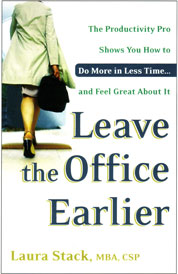 Laura
shows you how you CAN get more done than you ever thought possible and still get
home to your real life sooner. Laura
shows you how you CAN get more done than you ever thought possible and still get
home to your real life sooner.
The New York Times calls Leave the Office
Earlier, "...the best of the bunch."
The Library Journal, New York, NY named Leave
the Office Earlier one of the "Best Business Books 2004"...
Order this indispensable tool for the overworked
and time challenged at Amazon.com and receive 20% off its retail price.
More of The Productivity Pro's Resources
|
| Words
of Wisdom |
|
“Motivation is what
gets you started. Habit is what keeps you going.” – Jim Ryun
“If a task has once begun.
Never leave it ‘till it's done.
Be the labor great or small.
Do it well or not at all”
-Anonymous
“Divide your movements into easy-to-do sections. If you fail, divide
again.”
-Peter Nivio Zarlenga
|
Where in the World
is Laura? |
|
These are all private client engagements with Laura Stack. At this
time, Laura does not offer open enrollment seminars to the general
public. If you're interested in bringing Laura into your
organization for an employee training seminar on the day prior or
the day after one of these engagements below, please contact
John@
TheProductivityPro.com for special "piggyback" pricing.
March
25::Denver, CO
April
2::Parachute, CO
4::Highlands Ranch, CO
4::Highlands Ranch, CO
11-13::Las Vegas, NV
15::Aurora, CO
17-18::Orlando, FL
25::Myrtle Beach, SC
29::Philadelphia, PA
May
1::Denver, CO
7::Philadelphia, PA
8::Philadelphia, PA
13::Denver, CO
14::Phoenix, AZ
15::San Diego, CA
20::Atlanta, GA
21::NYC, NY
22::Saratoga, NY
28::Kansas City, MO
June
13::Highlands Ranch, CO
19::Denver, CO
24::Chicago, IL
July
8::Denver, CO
30::NYC, NY
October
14::St. Cloud, MN
24::Niagara Falls, NY
November
18::Phoenix, AZ
December
13::Nashville, TN
Visit
Laura's
Calendar On-line for her complete availability.
|
|
| Feature Article |
|
Time Management is Dead: The New
Reality of Productivity
We’ve all been there. There’s mail
piled up on the corner of your desk. You have 37 unread e-mails. The
phone is ringing (not that phone – the other phone). And you’ll be
lucky if you can get through three of the fifteen items on your
to-do list.
Oh – and you have four hours of meetings ahead of you.
It didn’t used to be this way. The world has changed in the last
decade or so. Has your approach to time management changed with it?
If you find yourself stressed out and frustrated every time you try
to hunker down and take control of your time, there’s a good chance
that’s because you need a new way to think about time management.
Don’t fall into the trap of trying to force yourself to work within
a system that just isn’t compatible with the pace of your day or the
nature of your work. Just like electronic organizers are perfect for
some and others swear by paper planners, even the best time
management system will fail if it doesn’t jive with the way you get
through each day.
If you’re looking for a productivity system that is compatible with
real life, consider 4-A Time Management. By focusing on four key
elements of productivity you can create a flexible, customized
productivity strategy that is compatible with the fast paced demands
of today.
Activity. When there are 117 things that could be done next,
how are we supposed to prioritize? In this new era of productivity,
it is pretty much impossible to successfully schedule your day in
advance. You might set out a clear list of objectives and a
bulletproof timetable, but we all know that one unexpected phone
call can cause the whole plan to collapse in on itself – priorities
change, a crisis pops up, a deadline is moved up a week; these
things happen.
Since you can’t plan for everything, it is important that you have a
crystal clear understanding of what your priorities are. If
something happens that is beyond your control and these priorities
need to be adjusted – fine – but until then, you should have a game
plan.
Evaluate your to-do list to see which tasks will yield the greatest
benefit. The old A-B-C method probably won’t work if the flow of
your day changes often. You need a new method of deciding where to
spend your valuable time.
Think about the average amount of time that you can work
uninterrupted. Which of your tasks will benefit most from that
undivided attention? Which require a lot more or much less? Make a
plan to work on the bigger, more time-intensive projects when you
know you’re least likely to be disturbed. Save the little ones for
those windows between meetings and phone calls when you won’t get
much else done.
If one of your important projects is just too intimidating for you
to ever make any headway, break it down into smaller, manageable
steps. I guarantee that nine times out of ten, once you get started
you’ll forget why you put it off for so long to begin with.
Availability. The best laid plans won’t stand a chance if you
don’t find a way to control your availability. Your time is your
most valuable asset. Don’t just give it away to anyone who asks!
You’ll never have complete control over your availability, but it’s
important to know how to carve out blocks of distraction-free time
that is conducive to productivity.
Meetings are notorious for eating up massive blocks of time. Learn
to say “no.” It’s pretty likely that you don’t need to be at all of
the meetings that you’re attending. Can you send someone in your
place? Ask for the minutes to be forwarded? Address the situation
with a quick phone call? Evaluate whether the meetings you attend
are really necessary.
When you’re not in those meetings, schedule time to work. In some
jobs this is easier to do than others. It might just be a matter of
shutting your office door and setting your phone to voicemail. Or
working from home or heading to Starbucks with your laptop. You
might need a clear signal for your co-workers, like using a
do-not-disturb sign or putting on head phones when you need to work
uninterrupted.
Whatever your solution – don’t abuse it. If you try to make yourself
constantly unavailable, you will quickly find that others lose
respect for your “I’m busy” signal.
Then you’re right back where you started, whether you’re up against
an important deadline or not.
Accessibility. You’ve already decided that you aren’t going
to give everyone around constant access to your time. The next step
is to make sure that you have easy access to the information, tools,
and resources you need to be productive.
Invest the time necessary to make sure the things you need on a
regular basis are at your fingertips. Things you access frequently
should be filed on your desktop in an organizer or in a drawer
that’s at arm’s reach. Put the files you only use occasionally where
they are accessible at your desk, but give the easiest access to
those things that you reference regularly. Archive files you rarely
need in the bottom drawers or in files away from your desk.
Perhaps the most important and overlooked thing you can do to get
organized is to structure your electronic files. In an age where
most files are electronic, it’s easy to lose them to the vacuum of
cyber storage. File electronic documents similar to the way you
would paper ones. Don’t just plop everything in “My Documents” or on
your desktop and leave it for lost. Set up folders and sub folders
that have intuitive titles that you’ll easily navigate. Use dates
and enough detail in file names that you won’t have to open multiple
documents when you’re looking for something specific. In short, do
the initial work of saving the files in an organized manner to make
referencing them an easy task.
Stopping to hunt for what you need not only wastes time, but it
destroys your rhythm and forces you to break your concentration.
It’s well worth it to organize as you go.
Attention. The most effective time management system in the world
won’t do a thing to improve your productivity if you don’t focus on
the task at hand. For many of us, the problem isn’t a lack of
willpower; it’s having the restraint to refuse distractions.
This means closing Outlook when you’re not working on e-mail and
trying to check it only a few times a day. Resist the urge to open
messages as they come in. This also means letting the voicemail
light stay on until you’ve finished what you’re doing. Treat your
project time like an appointment with a coworker. Ignore the phone,
the e-mail, and the urge to go get a cup of coffee.
Of course, avoiding email and the phone might be much easier than
avoiding the distractions that come from coworkers. If you’ve
already put your “do not disturb” signal in place, be it headphones
or a closed office door, and you’re still being interrupted, it’s
time to tactfully redirect the person distracting you.
Acknowledge the issue and let them know you’re in the thick of an
important project. Ask if you may give them a call in an hour when
they may have your undivided attention.
Just remember – it’s better to be like a postage stamp and stick
with something all the way to the end than it is to be a butterfly
that flits from task to task!
So forget managing your time – it can’t be managed. Manage yourself
with these 4 A’s and you’ll increase the likelihood you’ll have a
productive day.
Make it a productive day! ™
|
|
| Educational Resources from The Productivity Pro® |
Browse the Productivity Store for a variety of resources to improve your personal and professional productivity.
|
|
|
Ask the Productivity Pro� |
Q: I'm interested in finding some
information about productivity and depression in the workplace. This
company I interviewed at has cubes that are like boxes. The walls
are very high on each cube and the space very small. If you look out
your door all you see is another wall. How would this affect a
person when you can't see anything but walls in a 4 X 6 environment
with no way to stretch your eyes or view of a window to the outside?
I can't work here because I would feel like an experiment and it
would depress me to not see anything but cork board all day. Isn't
it important to have some openness, or is this only about putting as
many people in a room as possible?
A: I agree with you…I couldn’t work
there either. According to a study reported in the American Journal
of Psychiatry, the effects of productivity loss due to depression
(from any cause---not specifically cubicle environment) were
equivalent to approximately 2.3 days absent because of sickness per
depressed worker per month of being depressed. Productivity losses
related to depression appear to exceed the costs of effective
treatment. The best treatment of all would be to avoid it all
together. I could imagine that the environment you described could
contribute to depressive incidents in those tending toward the
illness, although some people who are in noisy environments probably
think your description sounds like heaven, so I couldn’t say
conclusively. Companies have battled with the question of productive
work environments for centuries and today generally swing to one of
two extremes with cubicle layout. They either embrace a completely
“open space” design with low walls, where you can see (and hear) all
the people around you. Employees tell me the noise level is
unbearable, with speaker phones, loud conversations, music, smells,
etc., that it’s nearly impossible to concentrate and hear yourself
think. Then some organizations swing completely the other way,
similar to the environment you speak of, where walls are high and
you can’t see anything, so you begin to feel claustrophobic, like a
rat in a cage. Obviously the best answer is somewhere in between,
which allows privacy when desired and teamwork where needed, where
movable, community areas where a team can gather ad-hoc; where
wireless internet is available throughout the campus, so workers can
leave the box and go somewhere they feel creative; where partial
glass partitions are high enough to buffer noise but blinds or
privacy screens can be used to gain privacy. If you’re in a noisy
area, there are CDs that create “white noise” in your cubicle and
noise-canceling headsets and iPod can help drown out sound. In the
stilted environment you describe, you’d have to make an effort to
take regular breaks and go outside or at least get near a window.
Instead of emailing co-workers who sit in a nearby cube, send a
meeting invitation to request some time on their calendars to gain
some social interaction. Often once an email goes back and forth
several times, it’s a lot easier to pick up the phone or meet in
person to hammer it out. Either way, open your mouth and communicate
your concerns to management. Your responsibility is being the most
productive employee you can be, and leadership should be very
interested in rectifying anything you tell them impedes your work
and task focus. For more tips on battling depression at work, visit:
Depression affects productivity.
Treating
depression improves productivity.
Depression lowers productivity.
|
| |
|

Laura Stack, MBA, CSP
Publisher |
| Message from Laura |
Mark your calendar! The
Exhaustion Cure: Up Your Energy from Low to Go in 21 Days
hits bookstores on May 13, 2008.
Buy your copy at Amazon on May 13 ONLY and receive free
bonus goodies. Instructions on receiving your thank-you gifts
will follow in next months’ newsletter.
NEW! Sign up to receive my complimentary productivity text
tip-of-the-week—delivered right to your cell phone! Send a text
message to number 41411 with the word PRODUCTIVITY in the text.
Or go to click
here to subscribe. That’s it! You’ll automatically receive a
productivity tip of the week starting with the next edition.
Tips arrive on Sunday night with a suggested productivity focus
for the next week.
NEW! The Productivity Pro�, Inc. wiki! Other businesses often
asked to post information they feel will help my readers improve
personal productivity. Because I don’t want this newsletter to
become sales-focused, I’ve created a wiki where you can post
information, resources, hacks, templates, worksheets, articles,
and links on improving personal productivity. Visit http://productivitypro.pbwiki.com.
To be added as a writer, email [email protected].
|
|
Time Tips
and Traps Offered by Subscribers |
If you
personally (non-commercial submissions only) have a
productivity idea or use a tool, product, software package,
or service that really helps you be more efficient, send
your tips to
[email protected]. I will include your
contact information, or you may remain anonymous. Thanks for
helping your fellow readers become more productive!
I like a new service by Catalog Choice, in which you decide
which catalogs you want to receive. When you receive a
catalog you don't want, you enter it on your account and
select "Decline Catalog." They contact the merchant on your
behalf and request that they no longer send you their
catalog. Reduce the number of catalogs you receive in the
mail! One-stop-shop method keeps you from having to
unsubscribe to each one individually---a real time saver!
I found a great website by Dawn Bjork Buzbee, a.k.a The
Software Pro�, who is a certified Microsoft Office Expert
and Microsoft Office Specialist Master Instructor. Dawn
shares smart and easy ways to effectively use software
through her work as a software speaker, trainer, and
consultant. Discover tips, tactics, tools, and techniques to
help you to be more productive with the software programs
you use every day. I found some great keyboard shortcuts,
articles, how-to lessons, and software handouts at
her website.
|
|
Laura in the News! |
|
Here is a series of blog posts
by Steph Auteri reviewing my book Find More Time chapter by
chapter.
R = Reduction
One of the books, Leave the Office Earlier, by Laura Stack,
MBA, CSP is a great one to help you focus on different areas
of your life to reduce stress and have more of me time. One
of her topics has to do with reducing time wasters.
Beat the Clock |
|
Reprint Information |
|
All Articles (C)
1999-2008 Laura Stack. All rights reserved. This information
may not be distributed, sold, publicly presented, or used in
any other manner, except as described below.
Permission to
reprint all or part of this article in your magazine, e-zine,
blog, or organization newsletter is hereby GRANTED,
provided:
1. The
ENTIRE credit line below is present,
2. The
website link to
www.TheProductivityPro.com is clickable (LIVE), and
3. You
send a copy, PDF, link, tearsheet, etc. of the work in which
the article is used when published.
This credit line
MUST be reprinted in its entirety to use any articles from
Laura Stack:
� 2008 Laura
Stack. Laura Stack is a personal productivity expert,
author, and professional speaker who helps busy workers
Leave the Office Earlier� with Maximum Results in Minimum
Time™. She is the president of The Productivity Pro�, Inc.,
a time management training firm specializing in productivity
improvement in high-stress organizations. Since 1992, Laura
has presented keynotes and seminars on improving output,
lowering stress, and saving time in today’s workplaces. She
is the bestselling author of the books Find More Time
(2006) and Leave the Office Earlier (2004). Her
newest productivity book, The Exhaustion Cure
(Broadway Books), hits bookstores in May 2008. To have
Laura speak at your next event, call 303-471-7401. Visit
www.TheProductivityPro.com
to sign up for her free monthly productivity newsletter. |
|
Subscription and Contact Information |
Phone: 303-471-7401
Email: [email protected]
Web site: www.TheProductivityPro.com
Address: 9948 S. Cottoncreek Drive Highlands Ranch, Colorado80130
To subscribe or unsubscribe,
click the link provided on the bottom of a recent
newsletter.
If you enjoyed this newsletter, please forward it to interested associates so
they may subscribe.
|
|
Ask the Audience: NEW!
We got so many responses
from our first reader question that we’re running this column again with
a new question. Thanks for your helpful advice! If you can help this
reader, send your ideas on solving Mary’s problem to [email protected].
All submissions this month will receive an awesome productivity prize: a
free 8-day eCourse on how to find more time! To submit YOUR question to
pose to our thousands of readers, visit the
ask the
expert page on my website.
Q: Laura and readers,
I am a business woman and a mom. I make weekly goal lists for home and
work. I never seem to be able to check more than 1, maybe 2 things off
of these lists every week. I try to make these goal lists small and
manageable; they get smaller all the time! At work, unexpected higher
priorities often come up and I can't seem to accomplish my weekly tasks
which are expected of me. At home I have a son with mental illnesses,
and I never know what to expect, which can make it very challenging just
to get daily tasks done. I have improved my productivity in general
quite a bit after listening to you speak and reading your news letters,
and it has helped me out a lot. I am getting a lot more done in a day,
but a bigger problem has become clear - how do I accomplishing
maintenance while putting out fires? How do I make a goal list that
works, and leaves me with a sense of accomplishment by the end of the
week? How do I get these daily tasks done every week, especially when I
am behind on them and have a great deal of catching up to do? I really
want to take care of my own mental stability, and I need that "caught
up" feeling, but it really seems unreachable. It feels like "one step
forward, two steps back". I appreciate any advice or thoughts you could
share with me.
Thank you everyone for your help,
Mary Brown
|