Buy Laura's latest book, Find More Time, if you 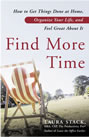 have a sink full of dishes to wash, three loads of laundry to do, 17 bills to pay, 26 emails to answer, a big stack of novels on the nightstand you'd love to read, and zero minutes of free time. You can't add more hours to the day, but Laura will help you make the most of the time you have and get things done. have a sink full of dishes to wash, three loads of laundry to do, 17 bills to pay, 26 emails to answer, a big stack of novels on the nightstand you'd love to read, and zero minutes of free time. You can't add more hours to the day, but Laura will help you make the most of the time you have and get things done.
Available now from Amazon.com and at better bookstores everywhere.
In Leave the Office
Earlier, 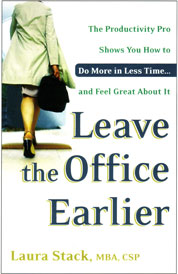 Laura
shows you how you CAN get more done than you ever thought possible and still get
home to your real life sooner. Laura
shows you how you CAN get more done than you ever thought possible and still get
home to your real life sooner.
The New York Times calls Leave the Office
Earlier, "...the best of the bunch."
The Library Journal, New York, NY named Leave
the Office Earlier one of the "Best Business Books 2004"...
Order this indispensable tool for the overworked
and time challenged at Amazon.com and receive 20% off its retail price.
More of The Productivity Pro's Resources
|
| Words
of Wisdom |
|
“Time is like
money, the less we have of it to spare the further we make it go.” –
Josh Billings
“Time = life;
therefore, waste your time and waste of your life, or master your
time and master your life.” – Alan Lakein
“This time, like
all times, is a very good one, if we but know what to do with it.” –
Ralph Waldo Emerson
|
Where in the World
is Laura? |
|
These are all private client engagements with Laura Stack. At this
time, Laura does not offer open enrollment seminars to the general
public. If you're interested in bringing Laura into your
organization for an employee training seminar on the day prior or
the day after one of these engagements below, please contact
John@
TheProductivityPro.com for special "piggyback" pricing.
February
12-17::San Francisco, CA
21::Irving, TX
26::Big Sky, MT
28-29::Raleigh, NC
March
4::Philly, PA
5::Philadelphia, PA
6::Philadelphia, PA
10::Atlantic City, NJ
13::Denver, CO
25::Denver, CO
April
2::Parachute, CO
4::Highlands Ranch, CO
25::Myrtle Beach, SC
May
1::Denver, CO
7::Philadelphia, PA
8::Philadelphia, PA
13::Denver, CO
14::Phoenix, AZ
15::San Diego, CA
20::Atlanta, GA
21::NYC, NY
22::Saratoga, NY
28::Kansas City, MO
29::St. Louis, MO
June
13::Highlands Ranch, CO
24::Chicago, IL
July
8::Denver, CO
September
9::Denver, CO
October
24::Niagara Falls, NY
December
13::Nashville, TN
Visit
Laura's
Calendar On-line for her complete availability.
|
|
| Feature Article |
|
How to Make the Most of 5:00-9:00
PM
Let’s forget about 9:00 to 5:00 for a
minute. We spend lots of energy making sure that we are efficient
and productive during the workday. But what about AFTER the workday?
Do you find yourself keeping your nose to the grindstone and working
diligently throughout the day only to have it all unravel when you
step through the door at home?
I hear it all the time: “I’m so exhausted when I leave the office,
but I always know there is more work waiting for me when I get home.
What can I do?” With most of the day behind us, it’s easy to lose
our focus and end up letting those precious hours at the end of the
day go to waste. Keep in mind that those weekday hours from 5:00
‘till 9:00 make up 20 hours of your week! Not many of us can afford
to waste that much time.
Ask yourself a few questions to help you make the most of those
evening hours and feel less stressed as a result.
How much television am I watching? For many, the biggest
culprit – by far – is television. There’s no reason you can’t enjoy
a favorite show or two, but don’t let it dominate your evenings.
Have you ever spent hours in front of the tube and barely even
realized it? You can’t get a single one of those precious minutes
back, and chances are that in a week you won’t even remember what
you watched. That’s a bad sign! See if you can turn it off for a
week. You don’t even have to spend the extra time doing something
particularly productive – just something different. Read a book.
Talk to your family. Organize a drawer or two. You’ll be amazed at
how much better you feel than you do after hours in front of the TV.
Where does the time go? Try keeping a diary for those 20
hours between 5 and 9 for one week. At the end of the week, it
should be clear where there’s room for improvement. Here are a few
things to look for as red flags, and some suggestions on how to
tackle them:
• The Internet: Do you sit down at the computer to check your e-mail
and end up spending an hour aimlessly surfing the internet?
o The Fix: Limit e-mail checking to just that. If you want to surf,
go ahead – just do it after the rest of your “home” work is done.
• Continuing the Workday: Do you have a habit of bringing the office
home?
o The Fix: Do it, if you must. But consider the value of your time
and the things you are sacrificing to continue the workday. If you
have to work at home, have a schedule and a plan of exactly what you
need to accomplish. If you can just leave work at work, even better.
• Dinner Plans: Does it take twenty minutes of staring into the
fridge to figure out what’s for dinner?
o The Fix: Take an hour on Sunday and plan 3-5 meals for the week.
Even if that means planning for take-out, know what you’re having
ahead of time. If you can, cook a meal or two over the weekend and
reheat them during the week to save time.
• Kid Wrangling: Are you spending a ton of time making sure homework
is done or working on kid-infrastructure like coordinating the
carpool and extra-curricular activities?
o The Fix: Get a plan – and a calendar. Hang a desk-sized calendar
in a prominent spot, and use it for the family’s master schedule.
This way, it’s all in one place and you can spend less time
coordinating on the fly. As for the kid-wrangling and homework: get
a routine going. Whether it’s first thing when you come through the
door or at a planned time each evening, block off time to do
homework or other structured activities.
• Chores: Are you working all day and then coming home to work
another few hours to catch up on the housework?
o The Fix: Don’t feel obligated to do it all, or even most of it.
Aim for one or two “large” tasks and a couple of small ones each
evening. Bring the family in on it, too. Throw a load of clothes in
the washer and then go clean up the living room. When you’re done
tidying up, fold the clothes. A little each night will go a long way
for the whole week and give you more free time on the weekend.
• Paper: Does it seem like your mail is taking over every horizontal
surface in sight? And that you’re constantly sitting down to pay
bills?
o The Fix: While the kids do homework, you should too. Sort through
the mail, file it in your tickler file by due date, and get it off
the counter.
What can I do that will have a positive effect on my life? So
many of the most personally rewarding things in life really do take
very little time. You just need to make them a priority. With your
newly-efficient schedule, you can now work in 20 minutes of
exercise, an hour to read a good book, or 45 minutes to sit down
with loved ones and catch up over a real dinner (with real
silverware and everything). It doesn’t take much, but the results
can be tremendous. You just have to commit to making it happen (and
encourage loved ones to do the same). While you’re at it, make time
for yourself. I’ll bet that no matter how tired you are, you always
manage to take care of family and friends when needed. Make yourself
a priority as well, whether it’s carving out time for a relaxing
shower or going for a rejuvenating walk around the block. You’ve
earned it.
What is my “perfect” schedule? There isn’t one. If you spend
all day at work and all night fretting about a demanding timetable,
you’ll drive yourself up the wall. Be flexible. Go with what works.
And don’t be afraid to adjust as necessary.
Make it a productive day! ™
|
|
| Educational Resources from The Productivity Pro® |
Browse the Productivity Store for a variety of resources to improve your personal and professional productivity.
|
|
|
Ask the Audience: NEW! |
This month, we feature YOUR answers
to Sharon’s question (below). All submissions received an awesome
productivity prize. To submit YOUR question to pose to our thousands
of readers
visit
the Ask the Expert page.
Q: Hi fellow productivity
enthusiasts, my name is Sharon.
I still have paperwork/old bills from my college days, which was
something like nearly 25 years ago, and I have shuttled these papers
to every re-location I've made over the years, so you can imagine
how many storage boxes I've had to move over the years... :)
I also work at a job (medical field) where I'm on my feet for 8
hours a day (sorta like a hospital with no office or place to put
your stuff except for a too skinny locker outside the department)
but don't have time for paperwork. At work we have to print out
important information to free space on the computer. Once I print it
out, I chuck it in my drawer because I'm too busy doing other very
important stuff. Other staff members get time to deal with their
paperwork, but if I even try to do a little bit of paperwork, the
work piles up and then someone gets mad at me because I'm trying to
work on paperwork and not doing the other stuff I should be doing.
Now my boss wants me to get that drawer "cleaned up" and possibly he
will be eliminating the drawers for good.
Are 3 ring binders a good idea??? I started using them (but not
faithfully - just for one thing) because there's always a
possibility of a "random audit" which is very important to have
these papers because if you don't, you are in very deep, deep
trouble or worse which means one could be out of a job.
I have searched and searched the internet for something SIMPLE and
EASY and yet I still am baffled because no one really covers stuff
like papers from ex spouses but still have my name on them, you know
that type of thing. I still have yet to find a "basic and simple
filing system/help" without having to go out and buy stuff or buy
color coded files or whatnot.
So you probably can see my frustration and why I beat myself down at
work and at home because I can't get control of the papers. HELP,
please.
Thanks for listening and hope to hear from you.
Sharon
Answers:
Whatever you do, do NOT go to
three-ring binders! What a waste of time: find the hole punch, punch
the hole, take out the binder, make space to open the book, open the
binder, put the paper in, close the binder, close the book, and put
it away.
How about a hanging file on the desktop? About 6" deep, it'll hold
folders and you can just drop the page in.
I'm a big believer in "if you can't find it, you don't have it."
Throw out stuff you can get elsewhere and stuff you won't need. I
think, "I might need this one day, but there's a 95% chance I
won't," so I pitch it. Start at the oldest and dedicate 15 minutes a
day to pitching while you reminisce. If you only do 15 minutes
(never more) every single day, you won't hate the task and you'll
see a real change in a matter of days.
Oh, and obviously, shred the bills and other sensitive documents.
I've been known to bring in some stuff and shred it at the office,
or get a shredder for $10.
Waiting for the Filing Fairy won't work.
Alison Torvik
If Sharon is required to retain these
files as a matter of policy at her work place then it is incumbent
upon her employer to provide a suitable filing system. For
infrequently accessed files, I would not recommend 3-ring binders.
Too much work, labeling the binders, punching holes, inserting tabs,
etc. I would tell Sharon to devise a simple solution of lateral file
cabinets or regular legal file cabinets, outfit them with hanging
folders and a simple system for filing. If files are normally
retrieved (say for an audit) by date then file the papers by date.
Depending on the quantity she might create a separate file for each
month, quarter, or year. I would use a period that would store about
an inch or so worth of paper documents. As she prints a new
document, just drop it right into the correct folder. She should
also determine what the retention policy is at the company and when
the papers are no longer needed (e.g. after 3 years), toss them out.
Oh yeah, and ditch the 25 year old student papers. We moved a couple
of years ago and after throwing out mountains of old papers like
these (old bank statements, old tax documents, old receipts,
etc…about two pickups full), I haven’t even missed them.
Mike Hammel, PMP
Laura,
It sounds like Sharon is at heart a "paper pack-rat", with all those
old college papers that she can't bear to toss.
Regarding the stuff at work that she has to print to free up space
on the computer, and which is only needed in case of a "random
audit" rather than being used day-to-day, Sharon should consider
copying the old files onto a CD or DVD so she can delete them from
her computer but still have easy access if needed for audit. A
recordable CD/DVD would allow files to be added over time, so she
could use the same filing system that she has on her computer to
organize the material by subject or whatever. If her computer
doesn't have a built-in CD/DVD burner (most of them do now), she
could get one that attaches externally by a cable - they are not
expensive. Each CD/DVD can hold a huge number of files, so it's very
space-efficient for storage and very quick to copy the files - no
paper-sorting required!
Alwyn Wood
Oh my goodness I feel for this girl!
Yes, first of all, the college paperwork should just go in the
trash. Especially after 25 years. The work situation sounds rather
time wasting and messy to say the least. If there is paper being
printed in order to free up space on the computer, I would suggest
deleting unimportant files on the computer rather than printing and
trying to find a place to put all that paper. Or, as it prints, if
it must be printed, decide right then and there if it is to be kept
and where and just deal with it immediately. Putting things away
into a drawer only delays the entire process. Hope this helps.
Joyce L. Cerutti
First of all, determine what the
"statute" is for the papers in question. Many times 7-10 years is
more than adequate and the remainder could be tossed (or shredded
depending upon their nature). I tackle this in two very different
ways -
1. At home - I am a three-ringed binder person. For me, it just
seems much easier to put things in order (chronological,
alphabetical, etc.). I have a binder for each year. After the
statute, the papers are shredded and the binder is recycled.
2. At work - we store our records in bank boxes. After placing the
items in the box, I clearly label the contents and include the
statement "may be disposed of after ____ (date)" on the outside of
the box. This way, when the date comes, no one has to go back
through and decide what needs to be saved, what dates they were
from, etc. The box can just go to the shredders.
Jessica McLaughlin
|
| |
|

Laura Stack, MBA, CSP
Publisher |
| Message from Laura |
Valentine’s Day is Thursday,
February 14th! Commit to leaving the office earlier that day to
spend more time with your sweetheart. Hectic work schedules have
probably ruined more Valentine Day celebrations than we care to
think about. It is easy to schedule business dinners for
February 14th without a second thought…until the day before…when
it finally hits us. More so than expensive jewelry or
chocolates, many people are satisfied with having the undivided
attention of a loved one for the evening. For more tips on how
to make it happen, please
visit my blog.
|
|
Time Tips
and Traps Offered by Subscribers |
To be featured in this
column, send your productivity tips to
[email protected].
I will include your
contact information, or you may remain anonymous.
|
|
Laura in the News! |
|
How Much Information Do You Consume?
Time management expert Laura Stack calls “incoming
information” one of the “biggest time and energy wasters in
your day.” If you’re feeling short on time—and who isn’t
these days?—she suggests going on a “low-information diet.”
It’s about time
How to Leave Work Early and Enjoy Your
Valentine's Day
Laura Stack, Day-Timers Expert on Productivity and
author of Leave the Office Earlier, has these tips to help
you create an unforgettable Valentine's Day.
|
|
Reprint Information |
|
All Articles (C)
1999-2008 Laura Stack. All rights reserved. This information
may not be distributed, sold, publicly presented, or used in
any other manner, except as described below.
Permission to
reprint all or part of this article in your magazine, e-zine,
blog, or organization newsletter is hereby GRANTED,
provided:
1. The
ENTIRE credit line below is present,
2. The
website link to
www.TheProductivityPro.com is clickable (LIVE), and
3. You
send a copy, PDF, link, tearsheet, etc. of the work in which
the article is used when published.
This credit line
MUST be reprinted in its entirety to use any articles from
Laura Stack:
� 2008 Laura
Stack. Laura Stack is a personal productivity expert,
author, and professional speaker who helps busy workers
Leave the Office Earlier� with Maximum Results in Minimum
Time™. She is the president of The Productivity Pro�, Inc.,
a time management training firm specializing in productivity
improvement in high-stress organizations. Since 1992, Laura
has presented keynotes and seminars on improving output,
lowering stress, and saving time in today’s workplaces. She
is the bestselling author of the books Find More Time
(2006) and Leave the Office Earlier (2004). Her
newest productivity book, The Exhaustion Cure
(Broadway Books), hits bookstores in May 2008. To have
Laura speak at your next event, call 303-471-7401. Visit
www.TheProductivityPro.com
to sign up for her free monthly productivity newsletter.
|
|
Subscription and Contact Information |
Phone: 303-471-7401
Email: [email protected]
Web site: www.TheProductivityPro.com
Address: 9948 S. Cottoncreek Drive Highlands Ranch, Colorado80130
To subscribe or unsubscribe,
click the link provided on the bottom of a recent
newsletter.
If you enjoyed this newsletter, please forward it to interested associates so
they may subscribe.
|
|
Ask the Productivity Pro�
Q: Laura,
Could you comment on the use of cell phones to improve productivity?
What are the advantages and disadvantages of cell phones in the work
environment? What is the impact on the social and ethical behavior of
people?
Khaleza
A: Dear Khaleza:
It’s hard to believe that cell phones have only in the last 10 years
become an integral
part of our social infrastructure. Increasing mobility is the way of the
future, and the real benefit of mobility is that when you need to do
business, you can. I believe cell phones improve productivity both in
the office and with field workers. Unfortunately with a global economy,
direct contact with customers and team members isn’t always possible.
Cell phone use can supplement “face time” with immediate voice contact.
Such immediate-response capability is achieved only when you can reach
or be reached by the right people and actually talk to them. Your phone
becomes a virtual device that follows you wherever you go.
With such an increasingly competitive world, real-time information can
make all the difference to mobile worker effectiveness and company
success. Cell phones reduce the barrier of access, and increased access
increases productivity. Access to timely and accurate information is
especially important to the growing number of mobile workers.
Cell phones help businesses extend their
reach. From globalization, to the pace of product development, to
changing customer relationships, technology advances help competitors
and also raise performance expectations of customers.
One downside to cell phones is the invasion of privacy; being on call
24/7. Sales people or field workers must mange their emotions, either up
or down, and having a cell phone could invade their personal space to
always be up, which could be a chronic stressor.
Like anything, moderation is key. Enhanced technology is a great tool
for advancing personal and professional productivity, but consumers must
be careful not to fall victim to cell-phone pitfalls.
1. One-on-One time - If you’re with a client, or colleague, give them
your full attention. Your customer is your most important commodity. If
your cell phone rings, let it go to voicemail. You can follow up later
when you can give the caller your full attention.
2. Don’t interrupt meetings – If the meeting is important enough to
schedule, then keep each participant engaged on the topic, not the next
phone call. Interruptions can disrupt the flow of an otherwise
productive meeting, wasting time and causing everyone to lose their
focus.
3. Don’t multi-task – If you’re in the middle of an important project,
keep your mind on the task at hand. Don’t engage in a complex phone
conversation while doing anything else. You can’t give your customer or
colleague your full attention and offer your best perspective if you are
doing two things at once.
Submit your questions by
clicking
here. |