Laura Stack talks about getting things done more efficiently. (C) 2016 Laura Stack, All Rights Reserved. www.TheProductivityPro.com … [Read more...]
Laura Stack talks about getting things done more efficiently. (C) 2016 Laura Stack, All Rights Reserved. www.TheProductivityPro.com … [Read more...]

A few weeks ago, upon the invitation of an officer in a Fortune 25 corporation, I spent the day with his leadership team discussing the concepts in my newest book, Doing the Right Things Right: How the Effective Executive Spends Time. With many new initiatives in the pipeline, his leaders were facing time management challenges around getting everything done, personally and within their respective teams. While much of our conversation is confidential around specific business strategies of course, I can share some of the insights we discovered. I shared my 3T Leadership Model, which describes where leaders divide their time: Part I: Strategic Thinking (Business) Acting as the organizational strategist, with the focus on business goals. The leader monitors the big picture and makes sure … [Read more...]

I had the pleasure of attending a seminar today from a fellow faculty member of the Institute for Management Studies (my husband John Stack is the Chair of the Denver chapter), JASON WOMACK. Here are five awesome ideas I gained on how to boost your productivity: 1. If a meeting suddenly gets canceled, what’s the first thing you usually think? “Ooooh I can catch up”! Instead, Jason suggests you can never get caught up. Even if you “do email” all day on a Sunday, you’ll never get caught up. Instead, you should get ahead with any unexpected “found” blocks of time. Work on a long-term project and make progress—not just maintain. 2. Technology is massively key to personal productivity! Here are some great resources Jason offered: www.usemyiphonebetter.com and Speedkeys. Also use … [Read more...]
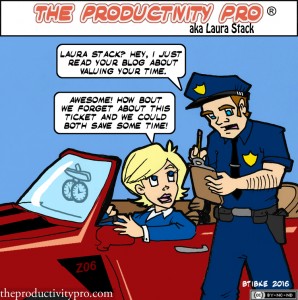
How much do you value your time? Maybe you've never seriously considered the implications of that question. To lead effectively, however, you have no choice but to address time-wasters and why they matter. You're important to your organization; otherwise, you wouldn't hold the position you do. Therefore, your time must also matter a great deal. Don't assume your value is equivalent to your salary; the amount of money you earn is likely to be a lot less than the true worth you bring to the table. That's one reason your leaders value you. To do the best job possible, value your time both realistically and highly. Depending on your leadership position, your value to the organization may be thousands of dollars per hour. Once you've pinned down the value of your time, use these tips as … [Read more...]

Every June, the U.S. Bureau of Labor Statistics releases the results of the American Time Use Survey for the year before. A regular publication since 2003, ATUS provides a fascinating glimpse into the habits of everyday Americans age 15 and older, from how much they sleep and watch TV to how many hours they work daily. In 2014, the BLS gathered survey data from interviews with 11,600 individuals all across the United States, in all walks of life. It turns out we Americans work harder than many people suppose, though a casual glance might suggest otherwise. Keep in mind, however, that the Survey sample included high school kids, the retired, the unemployed, the disabled, and those who hold part-time jobs as well as those who work full time. Some averages also include weekends, holidays, … [Read more...]
I'm a big believer in recovering lost time by killing timewasting behaviors, jettisoning useless tasks, and tightening work processes. But no matter how well you've triaged your schedule, you can probably do even more. That's because most of us engage in small, thoughtless actions or omissions that cost us time. Let's look at the worse time-nibblers you may still engage in. 1. Randomly checking email. Even if you've made a commitment to spend less time on your email, it's too easy to log on to see what's come in just before you knock off for lunch or take that much-needed break. Before you know it, you've lost 15 minutes. Clamp down on this temptation, unless you're expecting an important email that requires a prompt response. Spend time planning out a project instead. 2. Failing to … [Read more...]
"Action expresses priorities." -- Indian statesman Mahatma Gandhi. As Scottish poet Robert Burns pointed out in his poem "To a Mouse" in 1785, "The best-laid schemes o' mice an' men Gang aft agley, An' lea'e us nought but grief an' pain, For promis'd joy!" In other words, no matter how carefully you plan, things still go wrong. Among the most important schemes of the modern office worker, and therefore those most likely to "gang agley," are our priorities. Most of us compile exhaustive to-do lists and make serious efforts to triage our schedules, but sometimes priorities collide in ways we don't expect. A specific project may come due earlier or later than expected, conflicting with existing priorities; an emergency request may also raise its ugly head, or a superior might … [Read more...]
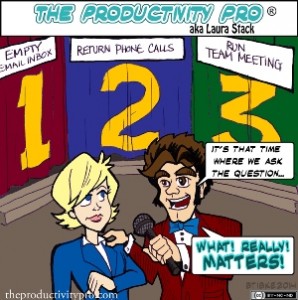
"It is not enough to be busy. So are the ants. The question is, what are we busy about?"—American philosopher Henry David Thoreau. As we enter 2015, I’d like to pose a question to anyone reading this who feels a bit overwhelmed: how will you regain control of your time? I've spent most of my career providing answers to that question, in terms of time management, self-discipline, setting personal boundaries, intelligent use of new technology, flexibility, speed, and more. The answers are many and multifaceted, because there's no single solution... and there really can't be as long as society and technology continue to evolve. I'm not sure we'll ever completely test all the options. Strategies like task management, setting priorities, and boosting ROI are basic to this process, and … [Read more...]

"There's no such thing as downtime for your brain." -- Jeffrey Kluger, American writer. As a survivor of the dot-com bubble and the Great Recession, you've probably developed a kind of "go-go-go" attitude about business and work. Agility, flexibility, and speed are the name of the game for those of us who want to maximize our productivity and success. But I admit I do sometimes get frustrated when other people or circumstances affect my productivity, and there’s seemingly nothing I can do about it. Going to my doctor’s office is a prime example. Because I know the value of time and respect her time, I arrive before my scheduled appointment and sign in. And then I wait. And wait. Then the nurse will eventually take me to a little room in the back, where she’ll leave me after taking … [Read more...]
"It seems to me that everything that happens to us is a disconcerting mix of choice and contingency." -- Dame Penelope Lively, British author. On the morning of February 15, 2013, a fireball ripped through the sky above the Russian city of Chelyabinsk, exploding 18 miles up after leaving a streak of fire tens of miles long. The minor asteroid, which was about the size of an apartment building, was actually the second to have visited the Siberian region in a little over a century: 1908's Tunguska meteor, which was about the same size, fortunately fell to Earth in an uninhabited wilderness, blowing down and charring 800 square miles of timber. The people of Chelyabinsk were lucky, because the meteor entered the atmosphere at a shallow angle. According to modeling done by Dr. Mark … [Read more...]